
An ordered Norman residents directory search
Start with the most specific detail already known. An exact Norman address is best handled through the City property locator, the County Assessor, GIS and then the deed index. A full name works differently: keep the middle initial, suffix, approximate dates and any Cleveland County connection, then test it against court, vital or historical sources. A single current roll is never a complete household list. Owner data can point to a taxpayer, a voting record has statutory limits, and an old directory is tied to its publication year.
For a request that needs an official response, send it to the custodian that keeps the underlying record. The City Clerk handles municipal administrative files; the County Clerk keeps recorded instruments; the Court Clerk handles district-court copies. That division keeps a useful inquiry narrow and avoids asking one office to combine records maintained by another.
- Normalize the street, direction, unit and any alternate address form.
- Check the parcel lead by address, then record its geonumber or legal description.
- Use the Clerk index to find a bounded instrument trail and verify the document with the Clerk.
- For a name, add a date range and compare at least two independent record types.
- For earlier households, move to directories, newspapers, maps and archive finding aids.
Norman residents directory custodians and their roles
Cleveland County holds the primary property and recorded-land trail for Norman. The Assessor supplies a parcel and valuation lead, while the County Clerk is the register of deeds and the source for the recorded instrument. The local Election Board is the route for voter information that is lawfully available. These offices answer different questions, so an address, a tax mailing field and a recorded deed should not be treated as interchangeable evidence.
The Clerk index points to references, but office copies or viewing provide the authority check. County GIS provides parcel and legal-description context, not title proof. Election Board staff can explain the qualified voter-list procedure when the portal does not fit.
Cleveland County Assessor
201 S. Jones Ave., Suite 120
Norman, OK 73069
405-366-0230
Cleveland County Election Board
641 E. Robinson
Norman, OK 73071
405-366-0210
Norman Address Starts With a Parcel
The County Assessor documents owner-name, physical-address and parcel-map searches for roughly 115,000 parcels. Treat the result as a structured lead, not proof that someone lives there. Record the shown owner or taxpayer name, situs address, mailing address, parcel or geonumber, legal description, tax year and valuation only when displayed. A mailing address can be outside Norman, and the research did not locate a published current coverage date for the online results.
Open the Cleveland County Assessor search to see its owner, physical-address and map entry points.
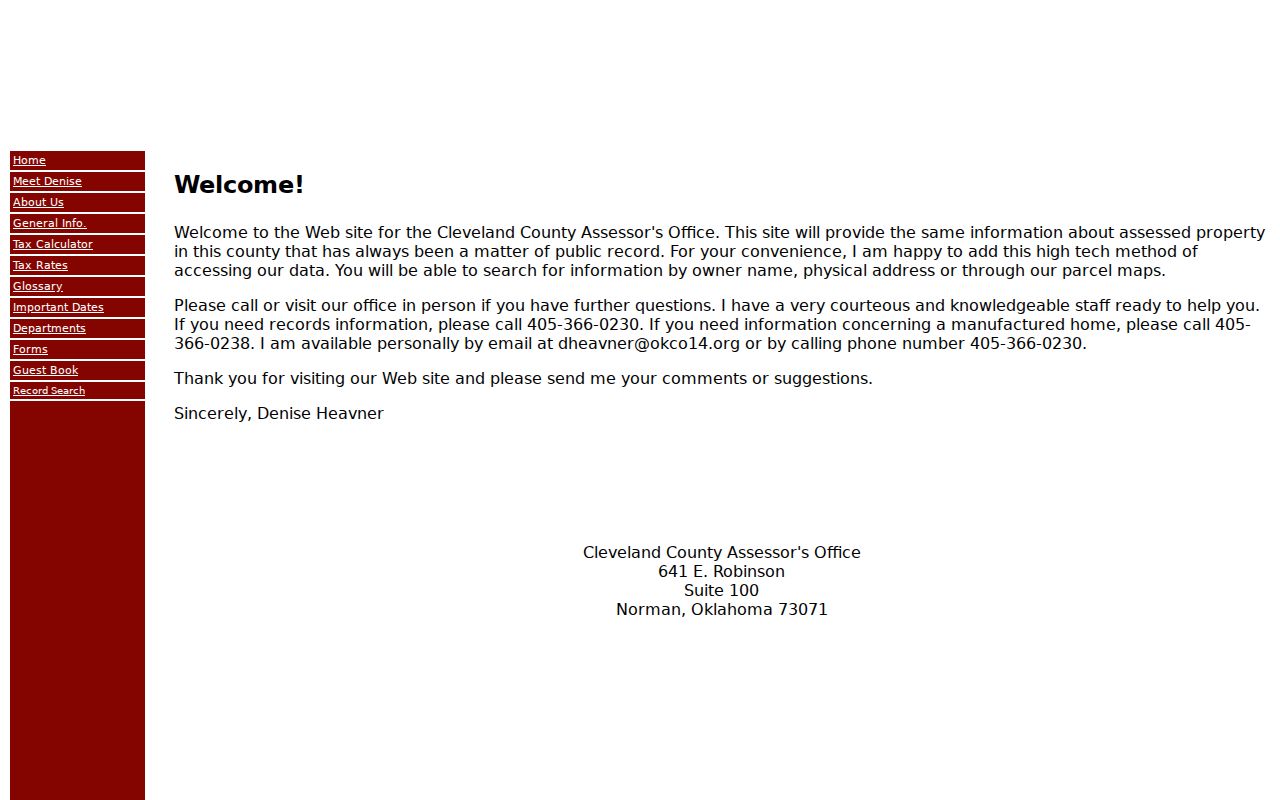
Use the displayed parcel identifier to compare the Assessor result with the County GIS and the recorded-instrument index. The deed or certified Clerk copy, rather than a tax listing, is the document to verify a conveyance.
The City’s property locator is a useful companion because it accepts a street address or geonumber and provides Property and Map tabs. It does not supply a complete published result schema or coverage date. Follow the Street Directory for the address-by-address sequence after the parcel lead is established.
See the Norman City property locator for its address-or-geonumber entry screen.
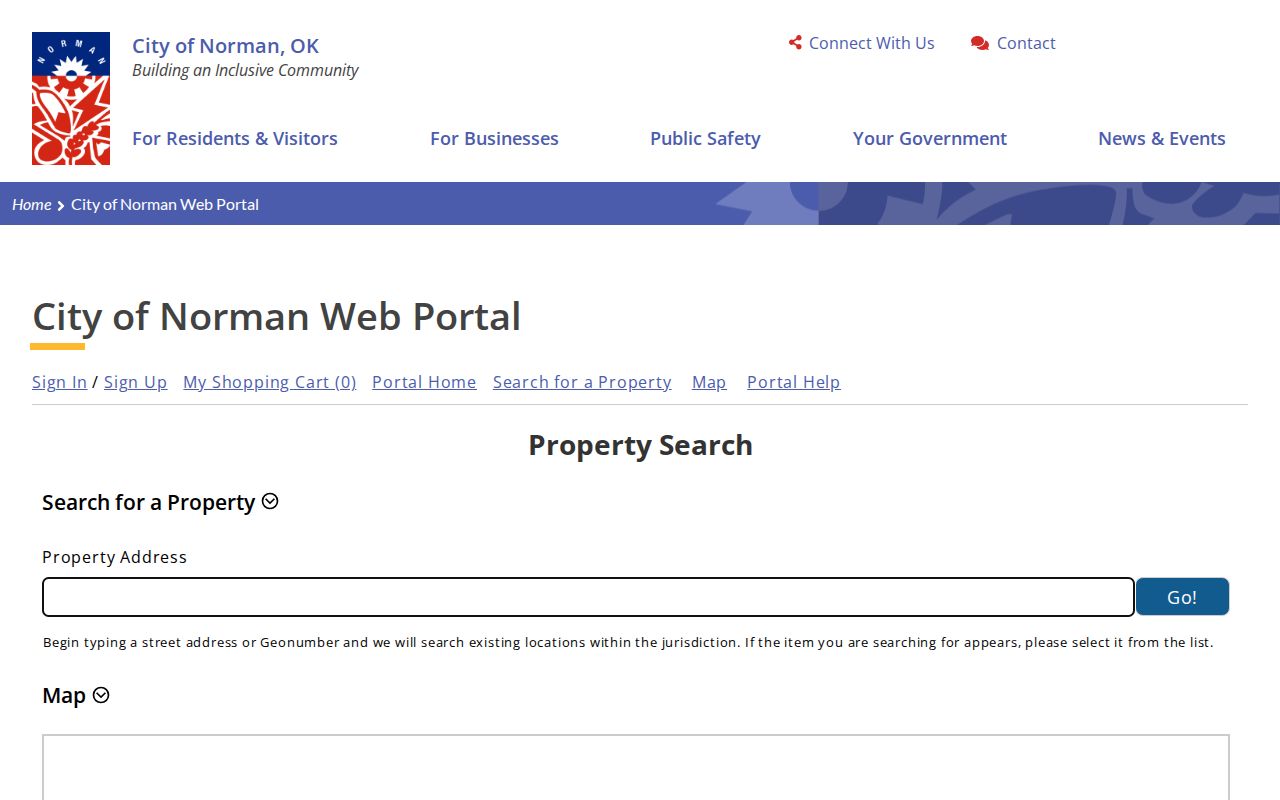
A City property result provides map context, while the County Clerk supplies the legal instrument trail. Keep those roles separate when a street string returns different results.
Norman Clerk Fields Refine Record Searches
The Clerk index has three distinct paths. Name mode takes a last and first name; the Clerk recommends an asterisk after the surname and a first initial plus an asterisk to broaden a search. Document Information works when the instrument type and a small date window are known. Subdivision mode accepts lot, block and subdivision combinations. The portal warns against large date windows and recommends no more than a month for heavy document searches.
| Clerk route | Fields documented | Useful result to retain | Important limit |
|---|---|---|---|
| Name | Last name, first name, wildcard variants | Party name, instrument number and filing date | Same names need another source |
| Document Information | Instrument type and bounded date range | Type, date and instrument reference | Full type list was not captured |
| Subdivision | Lot, block and subdivision | Legal-description connection | Parcel changes can alter the match |
Visit the Cleveland County Clerk document index before running a search.
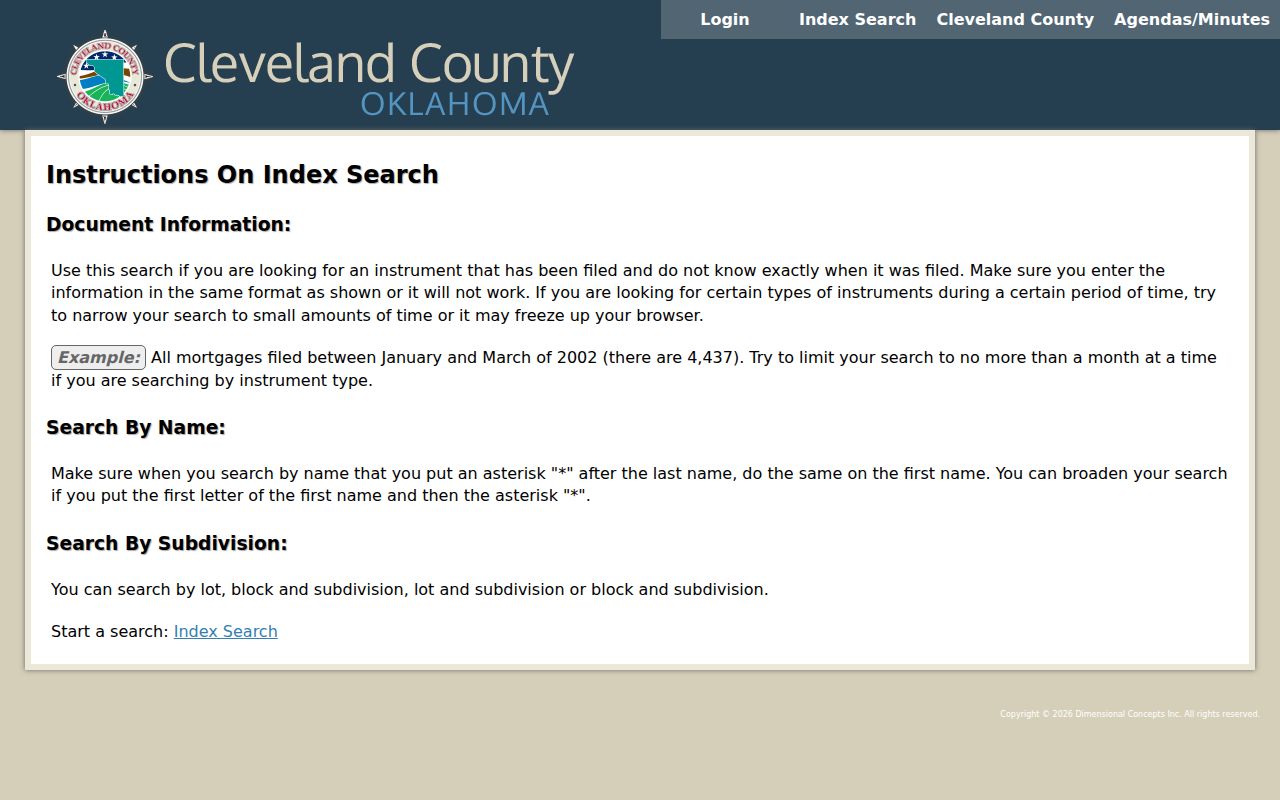
The index is explicitly reference-only. Its published disclaimer says the source data and images may be erroneous or outdated, so use the office viewing or copy route at 201 S. Jones, Monday through Friday from 8 a.m. to 5 p.m., to verify a document. The online coverage start and end dates were not located in official sources.
Norman Resident Sources Cover Different Roles
Current directory-like sources are best understood by what they actually record. Parcel systems identify a property or taxpayer lead. The deed index identifies people and entities named in instruments. Election information is public only through specialized rules, and protected records are not a gap to work around. A City permit can name an applicant or project contact, but that role is not the same as ownership or physical presence.
| Norman source | What it can show | Custodian | Access route and boundary |
|---|---|---|---|
| Assessor parcel record | Owner or taxpayer lead, situs, mailing and parcel data | County Assessor | Portal or office; not title or occupancy proof |
| Recorded-instrument index | Grantor, grantee, filing date and legal-description lead | County Clerk | Free index; verify with office document |
| Election record route | Authorized public registration and precinct information | Election Board | DOB portal or qualified request; protected records omitted |
| CityView permit record | Address, parcel, applicant or project status | Development Services | Online search; role must be labeled as shown |
| Official license registry | Public credential or status where exposed | Relevant state board | Scope varies; not a resident roll |
The Oklahoma Voter Portal is the state route for registration functions, sample ballots, polling-place information and absentee functions.
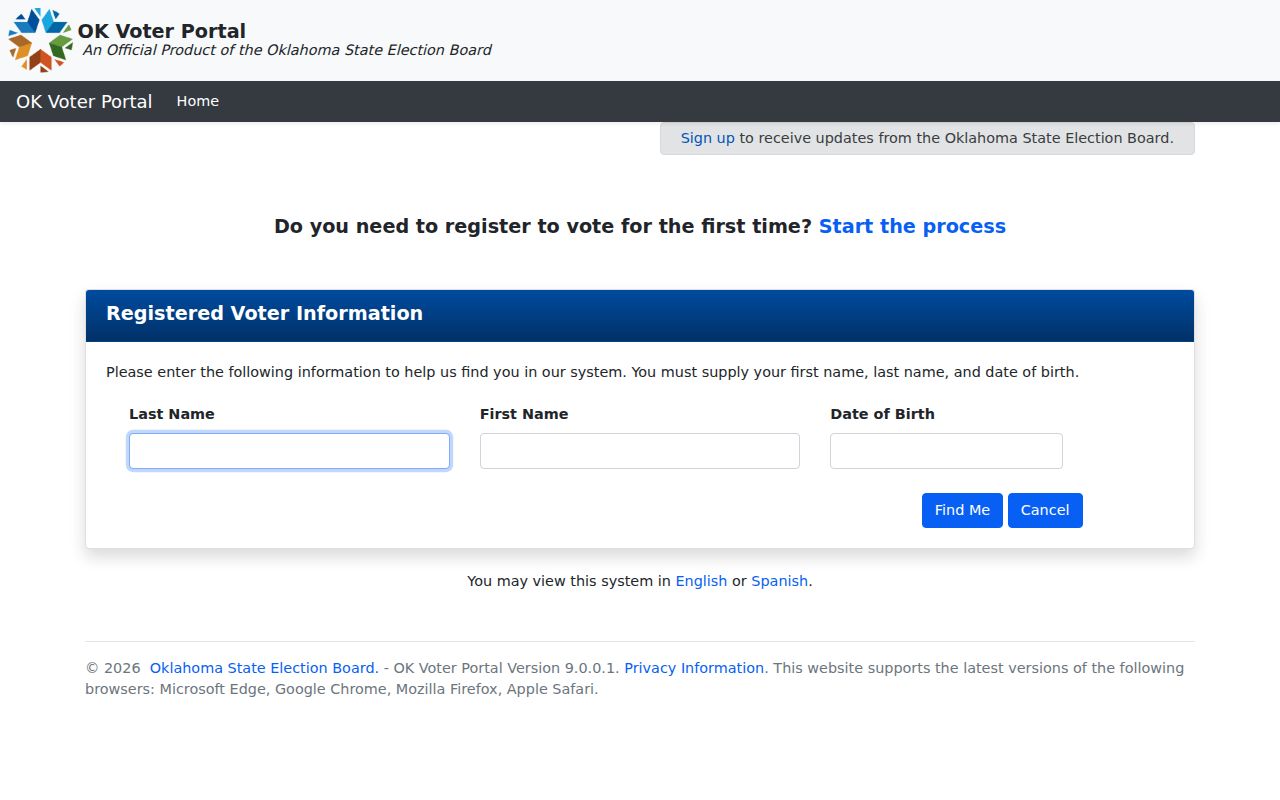
The State says portal access requires a date of birth, but the current field layout was not captured because automated research received a 403 response. A Cleveland County voter-list request has separate eligibility and lawful-use rules under 26 O.S. §7-103.2; electronic delivery can be free for qualified requesters, while physical-copy costs may apply.
Norman Record Sources Require Different Proof
An official index, the underlying document and a commercial people-finder category are not equivalent. The first can produce a lead quickly. The second can establish what the custodian actually holds. The third may be useful only as an unverified prompt to check an official source and may not identify its update date or provenance. Avoid expanding a search merely because one category returns a matching name.
An Assessor record can lead to a parcel and the Clerk index to a filing date, but neither resolves a same-name question. Pair them with the appropriate document, time range and independent source, then record why the match was accepted.
| Source category | Best use | Cannot establish alone | Next check |
|---|---|---|---|
| Official online index | Find an identifier, date or record route | Completeness or legal effect | Custodian document or counter |
| Certified or office copy | Verify the custodian record | Every later change or a complete household | Compare date and related record |
| Commercial people-finder category | Generate a question to test | Identity, current presence or source accuracy | Use an official, dated record |
Norman Court Records Split by Custodian
For Cleveland County district cases, use OSCN Docket Search and select Cleveland County. Party mode documents last, first and middle name fields, date-of-birth bounds, party type, case type, filed and closed dates, plus court selection. A result may display the case style, number, type, judge, parties, events, counts and docket entries. A CAPTCHA or changing interface can affect the online route.
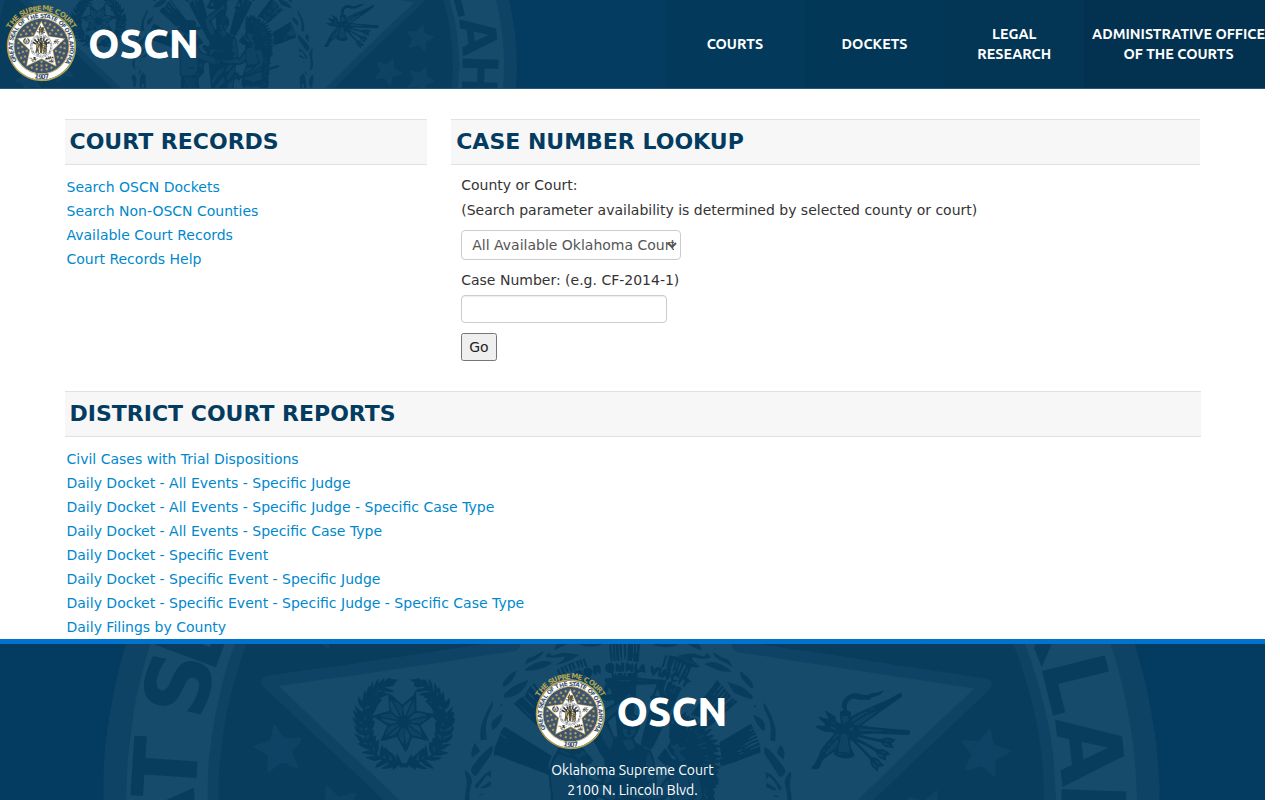
Do not merge a municipal record with a district-court record. Norman Municipal Court handles City ordinance, traffic and municipal matters, while the County Court Clerk handles district files. A docket entry needs its party role and disposition read in context, and sealed, juvenile, adoption and other protected files may not be public.
The Cleveland County Court Clerk records-request route directs searchers from OSCN to the copy request process.
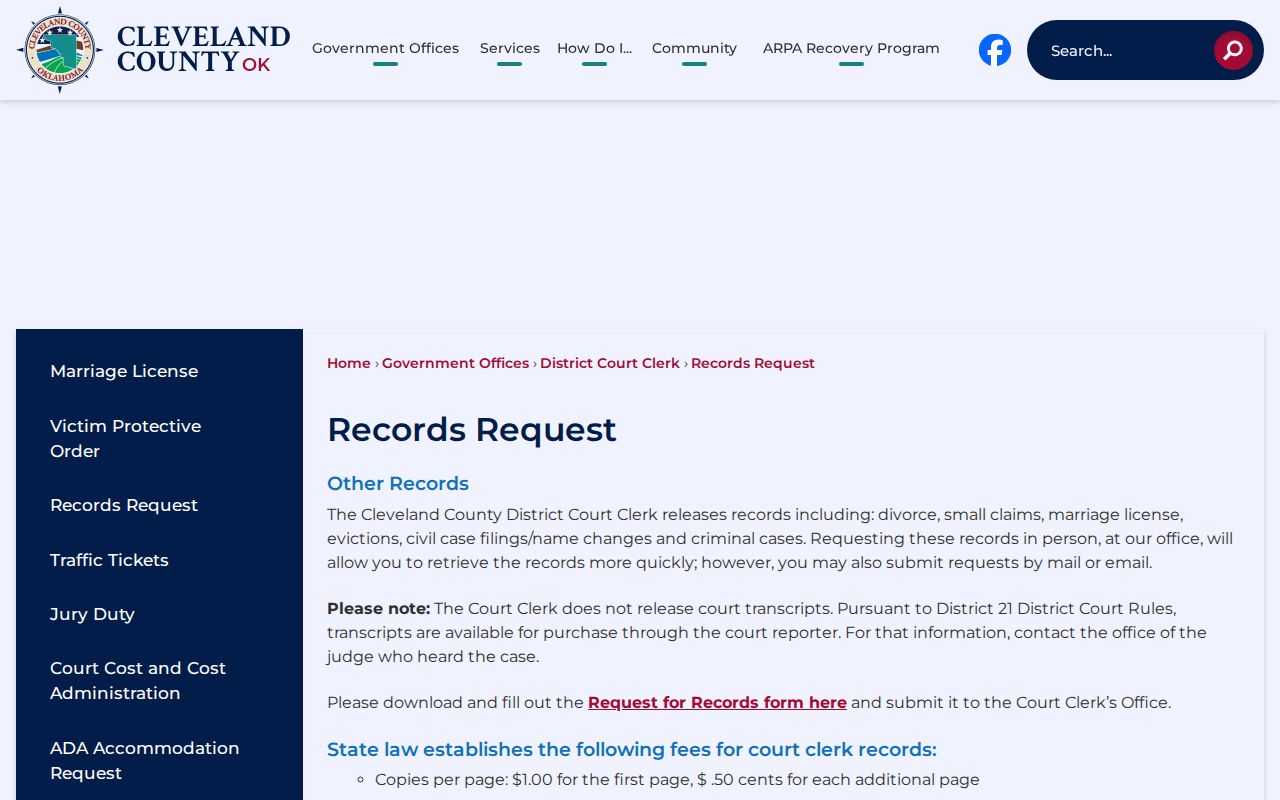
For a district-court copy, the Clerk accepts in-person requests, mail to 200 S. Peters Ave., and email at MARILYN.WILLIAMS@OSCN.NET; certified copies cannot be emailed. The form allows case, party, document and approximate-date details. Published processing is within 10 business days after payment, with $1 for the first page and $.50 for each additional page.
Norman Vital Index Has Limits
OK2Explore is Oklahoma’s free birth and death index. Its recorded search concepts are event type, subject name, event date, county and sex, usable in combination. The index is updated monthly and can contain transcription, handwriting or reporting errors. It is a historical and identity lead, not a current-address source. Birth events generally appear after 20 years and death events after 5 years.
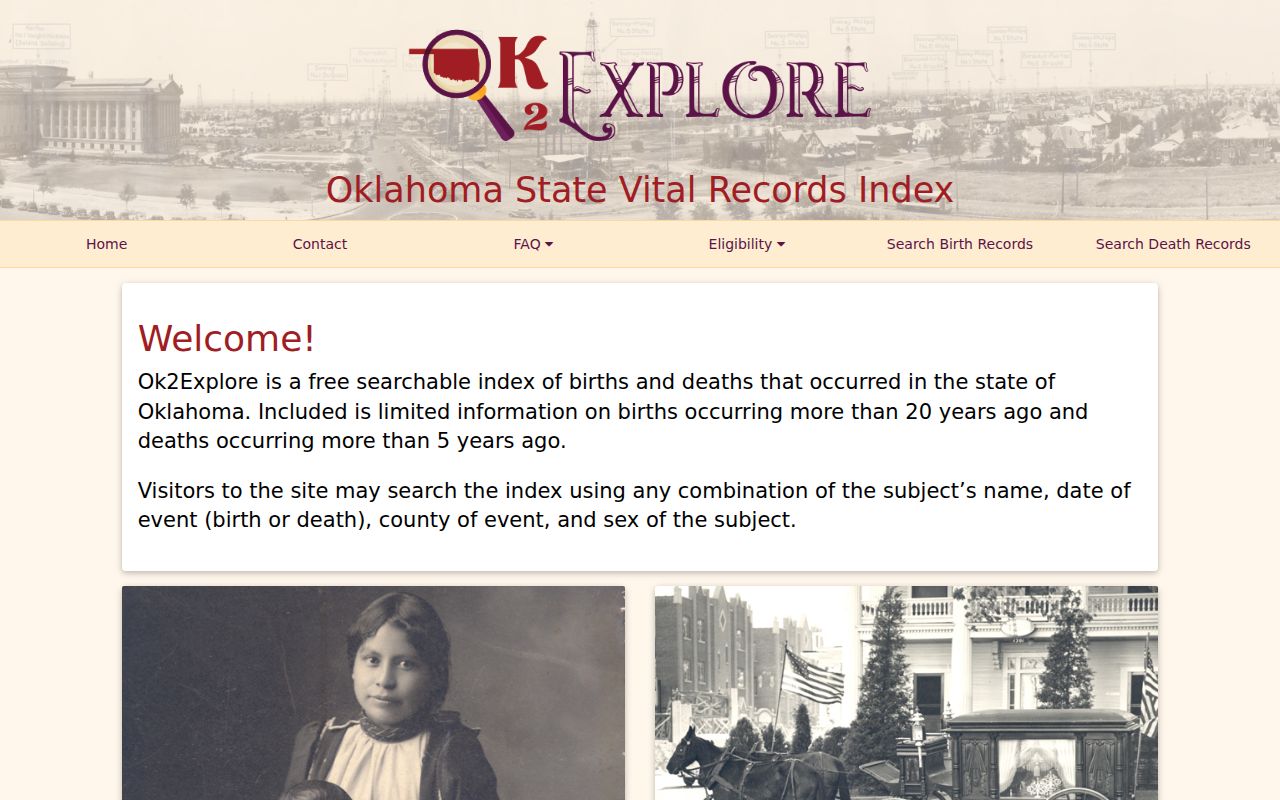
Certificate access is separate. OSDH says original records begin in October 1908 and that early filing was sporadic. The direct request path requires the current application, identification, payment and the eligibility that fits the record. The state lists a $15 search or copy fee and a mail route to OSDH Vital Records; VitalChek is an online option. The FAQ says walk-in service is not generally available, so confirm the live rule before traveling.
Norman Police Records Are Not Resident Rolls
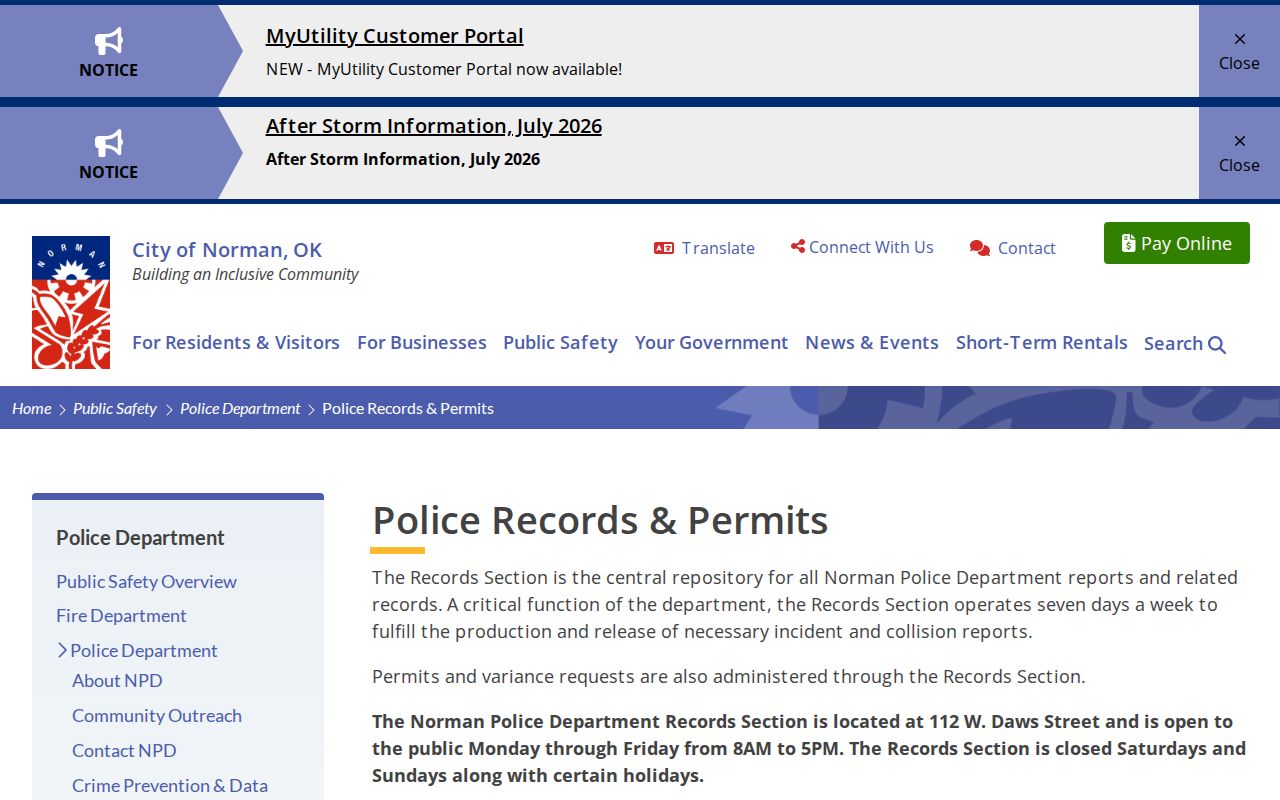
The Norman Police Department Records Section is the appropriate route for a specific report, incident or individual record check, subject to release and redaction rules. Requests can be made online, by mail, email, fax or in person at 112 W. Daws Street. The Records Section lists 405-366-5292 and rclerk@normanok.gov, and says most requests are processed within 48 hours after request and payment, while audio, video and photo work can vary.
Review the Norman Police Records and Permits guidance for the available request channels and fees.
Identify the date, incident location, report number and parties when requesting a releasable record. A police report does not establish everyone who lived at an address. Victim, juvenile, medical, driver and investigative information can be restricted, and a complaint is not the same thing as a final finding.
Norman Archives Extend an Address Trail
Pioneer Library System offers Norman East, Norman West and Library Lab as local starting points. Its resources page links Gateway to Oklahoma History, Fold3, HeritageQuest, NewsBank, the Oklahoman Archive and Oklahoma Docket Search. Some resources need a library card or in-library authentication. The digitized Norman Transcript is especially useful for 1889 through 1917, but OCR should be checked against the scanned page when a surname or street number looks uncertain.
Browse the Pioneer Library System research resources before choosing a database or asking reference staff about access.

For directory holdings, the Oklahoma Historical Society’s city-and-year search is an online lead, but its results are used at the Research Center rather than delivered online. OU Special Research Collections and Western History Collections add finding aids, manuscripts, maps, photographs and yearbooks; many Western History holdings are offsite, so appointments matter. The local Cleveland County Historical Society can add a context lead that should then be corroborated with a dated record.
Norman Resident Research Changes by Year
Historical directory work should be dated before it is interpreted. OHS says city directories may contain annual name and address listings, spouse information, government offices and classified sections, but the public form does not list the exact Norman annual run, call numbers or gaps. The 1941 Southwestern Bell Norman telephone directory is specifically a negative finding for reverse-address work: it is not a criss-cross directory. Do not promise a reverse lookup from that volume.
A practical older-address chain joins a dated directory with a County Clerk instrument and a Sanborn map. OHS lists Norman Sanborn years from 1894 through 1944, and the Library of Congress has a 13-sheet 1914 set. Those maps establish building and street context for their year, not a list of occupants. For fuller shelf-by-shelf help, use the Directory Book.
Norman postal geography is a research boundary
Norman is not one ZIP code. Supported Norman-area codes include 73019, 73026, 73069, 73070, 73071 and 73072. Nearby codes in broader search results should not be called incorporated Norman codes without an address-level USPS result. Postal boundaries, Census ZCTAs, city limits, county parcels and neighborhood labels are different systems. A ZIP alone does not prove that a person is at an address or that an address falls inside city limits.
Use the USPS address lookup for delivery standardization, then compare the resulting address with City and County maps. The City property portal is keyed to street address or geonumber, the Assessor to owner, physical address or map, and the Clerk to names, document details or subdivisions. That is why one street string can yield different records. Exact Norman ZIP history and a complete ZIP-to-neighborhood table were not located in official sources.
Norman Record Terms Improve Search Logs
Record systems use different keys for the same place. A City property search can begin with an address or geonumber, an Assessor search with owner, address or map, and the Clerk with party, document or subdivision details. Record the shown terminology so an address search is not mistaken for a deed search.
- Parcel or geonumber
- An identifier used by the Assessor, GIS or City property system to connect an address with a mapped property record.
- Situs address
- The physical property address shown in a record. It can differ from the taxpayer or mailing address.
- Recorded instrument
- A deed, mortgage, lien, plat, easement or similar item indexed by the County Clerk and verified through the underlying document.
- Criss-cross directory
- A reverse-address directory format. Its availability must be confirmed for the specific Norman volume and year.
- Sanborn sheet
- A dated fire-insurance map sheet that gives building and street context, not household proof.
Save the exact query, portal, search date, visible coverage statement, record identifier and reason a match was accepted or rejected. That log supports later review of same-name results.
Norman Family Research Crosses Record Eras
For an early household question, begin with a date bracket. Smith’s 1890 territorial directory has a Norman section, while the Norman Transcript in Gateway covers 1889 through 1917. Add the surname, a likely street form, business or institution term, and historical words such as Original Townsite or Norman’s Camp. Search spelled-out numbered streets and directions as OHS recommends, then inspect the original newspaper scan when OCR is doubtful.
Next, connect the name-to-address lead to an OHS city directory, Sanborn sheet and County Clerk instrument. A current city-limit map should not be projected backward onto an 1890 address. Norman’s 1889 settlement, 1890 county-seat status and 1891 incorporation help select the period, but the County Clerk’s online index does not state its earliest coverage year. Ask the office about earlier deed books or microfilm instead of assuming the portal is complete.
Norman Records Research Has Limits
Use a narrow, personal purpose. Confirm a family-history connection, follow a property or heir question, or verify an official record with its custodian. Do not use public records to stalk, harass or expose a person, and do not try to reconstruct information excluded by a protected-record program.
Oklahoma voter data excludes sensitive identifiers and can omit protected voters. The Address Confidentiality Program uses substitute addresses for eligible participants. Vital certificates have age, relationship, identification and application requirements. Sealed court matters, protected victim information, juvenile files and certain police material can be unavailable. A missing public result is not permission to seek the information through unrelated sources.
Norman Portal Gaps Need Other Channels
Online search is only one channel. The County Clerk index leads to office viewing or copies at 201 S. Jones. District court requests can go to the Court Clerk in person, by mail or email, subject to its copy and certification rules. City records go through the City Clerk’s online request route or its documented counter and fax channels. County open-records questions outside a specialized office route can be directed through the County’s request process under the Oklahoma Open Records Act, 51 O.S. §§24A.1–24A.33.
For a municipal case, contact Norman Municipal Court at 321 N. Webster; its request form records name, date of birth, address, citation and response-method details. For historical material, use the OHS Research Center, Pioneer reference access, OU finding aids and appointments, or the local historical society. State what is being sought, the date range and any instrument, parcel or case identifier. A focused request is more useful than asking an office to build a new directory.