
Norman Past-Address Sources by Era
Each source below answers a different part of a past-address question. The table deliberately preserves the local coverage gaps. A source may show a party to a deed, a name-to-address entry, a newspaper notice, or a building footprint, but none by itself proves continuous residence at a home.
| Source | Years or coverage found | Where held | What it can show |
|---|---|---|---|
| Cleveland County Clerk instrument index | Online start and end years not located | Clerk index and Clerk office | Recorded grantor, grantee, filing date, type, legal description, and prior-instrument clues |
| Norman city directories | Earliest known directory cited: 1908; library holdings back to 1926; complete annual run not published | OHS Research Center and Norman Public Library | Possible name, address, spouse, occupation, and classified-business clues |
| Reverse or criss-cross directories | 1930s through 1960s indicated; a fairly consistent 1950s and 1960s run is reported; exact years not listed | Pioneer, OHS, OU reference routes | Address-to-name research where the individual volume has that format |
| Norman Transcript | 1889-1917 title run | Oklahoma Historical Society Gateway | Notices, names, street clues, businesses, and events in dated scans |
| Norman Sanborn maps | 1894, 1896, 1898, 1901, 1904, 1908, 1914, 1918, 1925, 1944 | OHS; Library of Congress has a 1914 13-sheet set | Building, street, and nearby-business context at the map date |
| Federal census schedules | Released schedules subject to the 72-year rule | National Archives and authorized research databases | A household and geography at the enumeration date |
| City permit records | Online start year not located | Norman Development Services | Address, parcel, project, and named project role |
Start with the date you need to reach. A recent transfer calls for the Clerk and Assessor first. A question from the early Norman era may need a street form, Sanborn sheet, Transcript issue, and directory entry before a deed can be connected confidently.
Trace Norman Past Owners Through Deeds
The deed chain is the recorded-property trail, not a list of everyone who lived at an address. Begin with an Assessor or GIS parcel lead, use the legal description to locate the current instrument, and work backward through parties and referenced instruments. The Cleveland County Clerk is the register of deeds and keeps the instruments that must be checked for title-history questions.
- Use the Assessor or City property tool to record the current situs, parcel or geonumber, legal description, and displayed owner or taxpayer lead.
- Search the Clerk index for the current owner as grantee and for the legal-description or subdivision clues.
- Open the current purchase deed or obtain the office copy, then record its instrument number, filing date, type, grantor, grantee, legal description, and prior reference.
- Search the earlier party as a grantee, as well as name variants, trust or entity names, and the subdivision or lot and block details.
- Repeat until the date goal is reached, the legal description changes, or an unlocated instrument needs a Clerk, archive, or microfilm request.
- Grantor
- The party transferring an interest in a recorded instrument.
- Grantee
- The party receiving an interest in the recorded instrument.
- Chain of title
- The sequence of recorded instruments used to follow interests in the same legal parcel backward through time.
- Legal description
- The recorded land description, such as a lot and block or survey description. It is usually more durable than a street number when an address changes.
When a parcel is split, combined, replatted, or readdressed, do not carry a name backward on the street address alone. Compare the legal description and plat with the present parcel and flag a mismatch as a research issue.
Norman Past Owners in the Clerk Index
The Cleveland County Clerk index provides Name, Document Information, and Subdivision workflows. Name search uses last and first name, and its instructions recommend an asterisk after the last name and a first initial plus an asterisk for a broader search. Document Information helps when an instrument type and uncertain date are known. Subdivision search accepts lot, block, and subdivision combinations.
Use bounded date ranges. The Clerk’s own example says a three-month mortgage search can produce 4,437 results and suggests no more than a month to avoid a freeze. The public index is free, but the Clerk’s disclaimer calls its data and images reference material. Exact online coverage start and end years, document-type options, image access, and online-copy fees were not located in official sources.
The records-search entry point for this Norman backward-address workflow is the Cleveland County Clerk index.
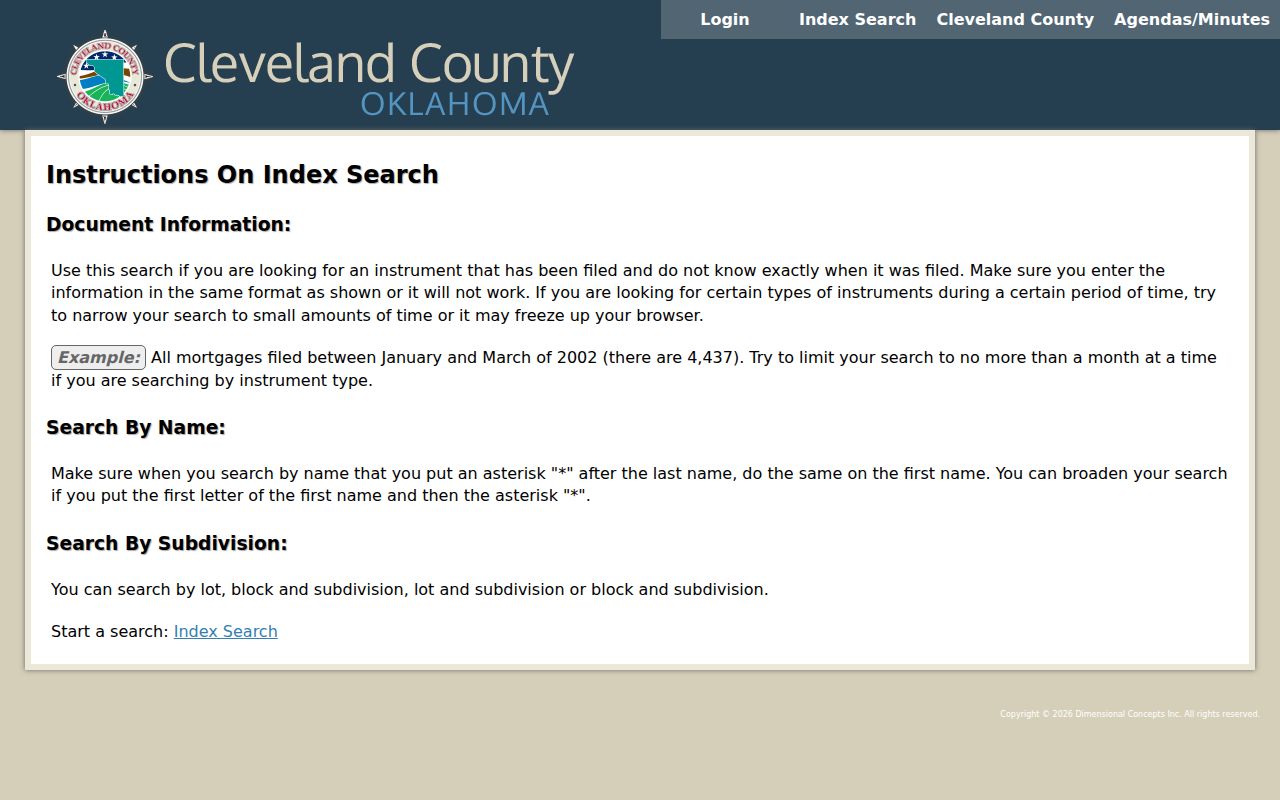
View or copy actual documents through the Clerk at 201 S. Jones Avenue, Norman, Monday through Friday from 8 a.m. to 5 p.m., or call 405-366-0240. If the indexed material does not reach the needed period, ask about office-held deed books or microfilm instead of assuming the online index is complete.
Note: Record an unlocated prior instrument by date and reference, rather than guessing that a missing online result breaks the property trail.
Norman Past Households in Directories and Newspapers
Directories and newspapers create a dated household trajectory around the deed chain. The Oklahoma Historical Society says city directories can include annual name-and-address listings, spouse and occupation information, government offices, and classified sections. Its online directory search has City and Year fields, but results are not delivered online; the Research Center visit is required. The Norman run, gaps, call numbers, and exact annual coverage were not fully listed publicly.
The OHS directory search capture provides the City and Year entry point for this past-residents source.
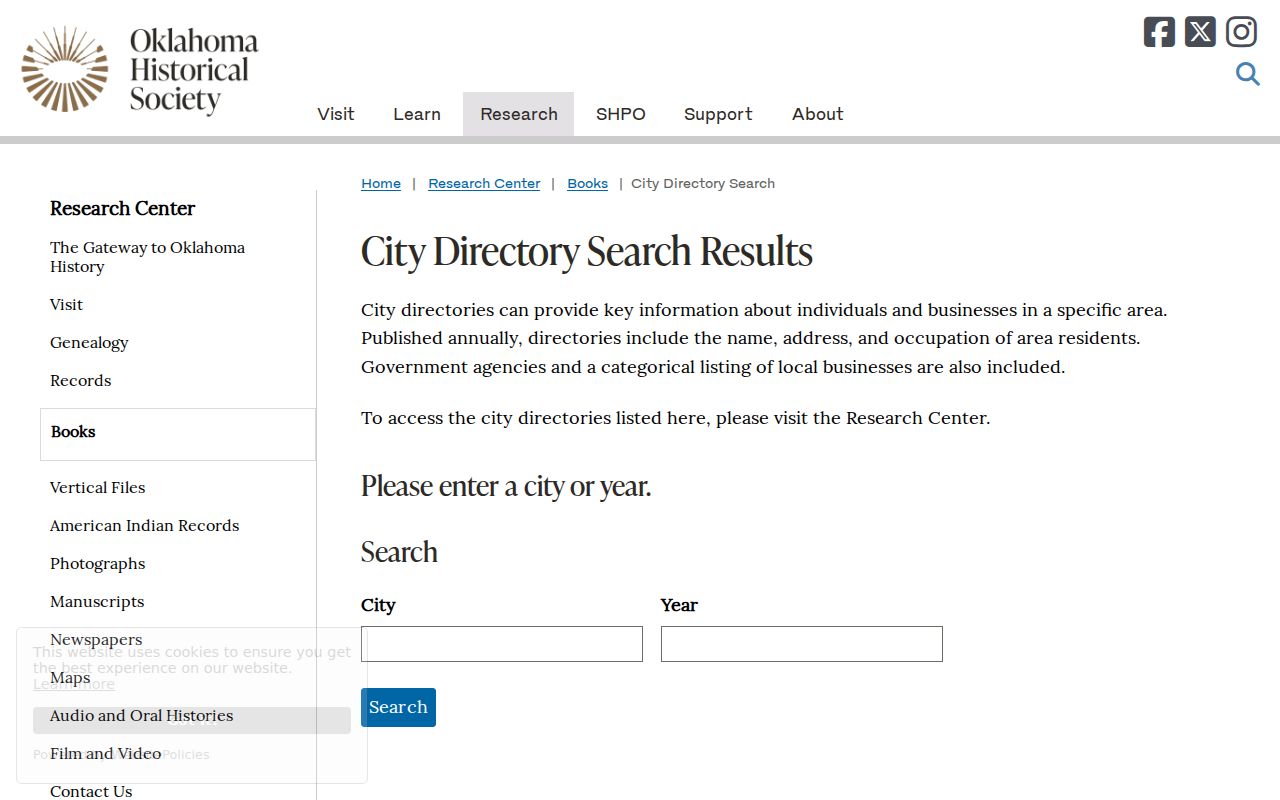
Use the result as a lead to an annual volume, then record the printed address, page, year, directory type, and any abbreviation key. A listed address can predate the printing date and is not proof of continuous residence.
The Norman Transcript is a free online title run from 1889 through 1917. Search a surname with address, business, nearby institution, or older street spelling, then inspect the original image because OCR can misread names and street numbers.
This source capture shows the digitized title page for the Norman Transcript collection in Gateway.
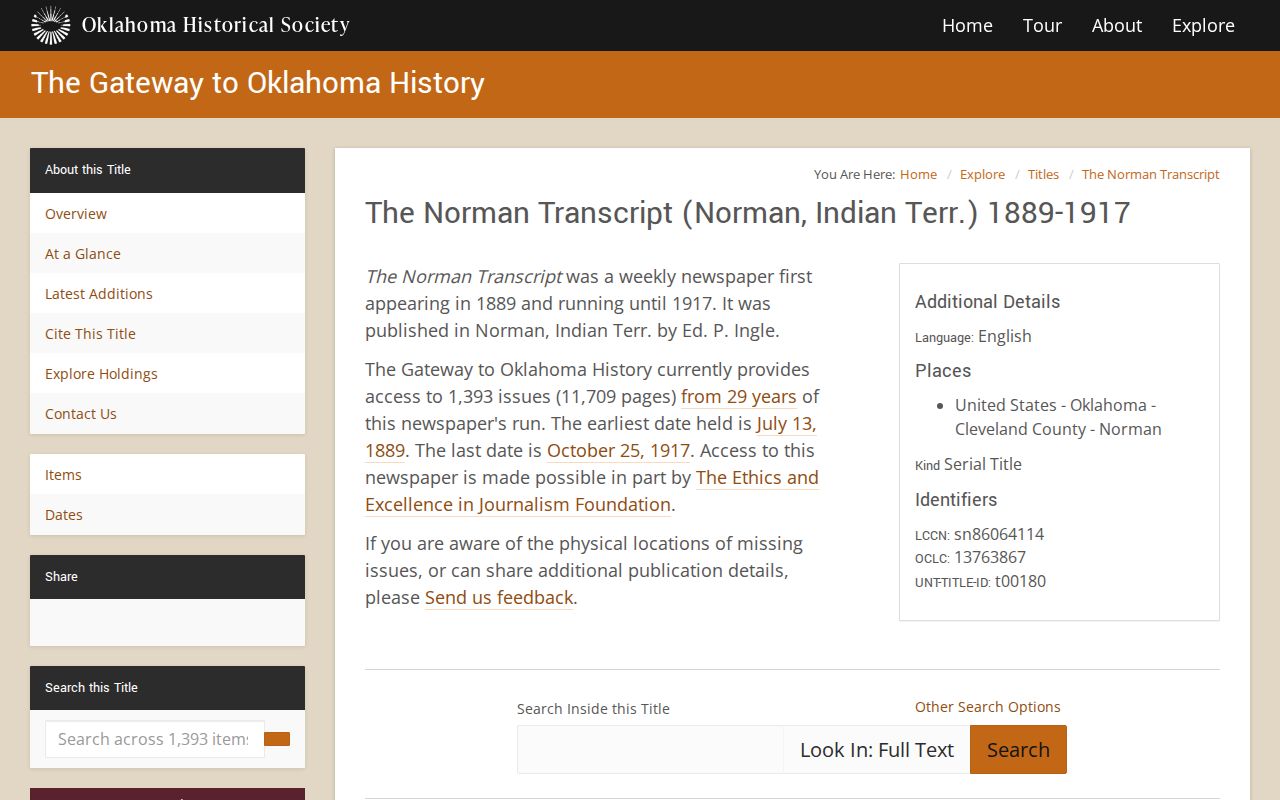
Pioneer Library resources also provide Gateway and other history databases, sometimes with library-card or in-library access requirements. Confirm the source year and inspect the scan before relying on OCR text.
Norman Past Addresses and Sanborn Map Years
Sanborn maps add physical context to an address at a particular time. OHS lists Norman sheets for 1894, 1896, 1898, 1901, 1904, 1908, 1914, 1918, 1925, and 1944. The Library of Congress makes the August 1914 Norman set available in 13 sheets. A sheet can show a building footprint, material, use, street layout, fire-protection features, and nearby businesses.
Maps are not resident rolls. Pair a map year with a directory, newspaper, deed, or census record from a close date. When an older house cannot be located by the current number, use the map’s street form, lot and block, and nearby landmarks with the legal description. This is particularly useful for the Original Townsite and other historic-area questions, but a planning label is not a parcel boundary.
Norman’s 1889 settlement, 1890 county-seat decision, and 1891 incorporation give useful date context, yet no courthouse fire, flood, or countywide record-loss event was found in the official sources reviewed. Do not invent a lost-record story to explain a gap.
Norman House-History Route
The Oklahoma Historical Society home-history guide supplies a practical order for a Norman house question: start with an Assessor owner or address search; copy the legal description and subdivision, lot, and block; search County Clerk deeds; then search directories, newspapers, and Sanborn maps. It advises using the address with likely owner names and spelling out numbered streets and directional forms.
Its warning about Assessor records is important: prior owners can be incomplete. Use the current parcel record as a lead, not a shortcut around the recorded instrument. For a current address or geonumber check, Norman Property Locate can be used online. The Assessor, GIS, and Clerk should be compared when the site, mailing address, or legal description does not line up.
In-person and archive fallbacks matter here. Pioneer has Norman East, Norman West, and Library Lab locations; OHS Research Center is at the Oklahoma History Center in Oklahoma City and can be reached at 405-522-5225. OU Western History Collections is open to non-OU researchers but requires appointments for offsite holdings. Cleveland County Historical Society and Moore-Lindsay House offer local-history leads that should be corroborated with a record custodian or dated source.
Pair Norman Households With Dated Sources
After the deed trail identifies a time window, build a small sequence instead of collapsing all names into one household. A directory can provide a name-to-address clue; a newspaper can add an event or date; a census schedule can identify the enumerated household for its specific date; a map can show the place at that map year. Keep each line tied to its source date.
- Set a date bracket from a recorded deed, tax year, directory date, or newspaper notice.
- Read the nearest directory entry and record the name exactly as printed, address, spouse or relationship notation, and page.
- Search the Transcript and other dated newspaper sources for the address, household name variants, business names, and street spellings.
- Pair the date range with a released census schedule only where the 72-year rule and source availability allow access.
- Use a deed, map, or property record as a second source before treating same-name results as the same household.
The 1941 Southwestern Bell Norman telephone directory is a useful negative finding: OHS survey material says it does not contain a criss-cross directory. It can provide the type of name-to-phone or address context its volume actually supplies, but it must not be presented as a reverse-address source.
Norman Past Addresses and Changed Street Forms
Old street research often breaks when a present-day address is treated as permanent. The official sources did not locate a Norman readdressing-history dataset, an E911 address crosswalk, or a fixed street-grid rule. Preserve the source’s exact street spelling, directional, unit form, subdivision, and legal description. Search old owner names and deed references when a map and directory disagree.
The City property portal accepts a street address or geonumber. The Assessor offers owner, physical-address, and parcel-map searches. County GIS describes legal descriptions through survey, metes-and-bounds, coordinate, recorded-plat, and lot/block/subdivision methods. Taken together, those systems can show that an address question needs a parcel cross-reference; they do not authorize an unsupported conversion from an old number to a new one.
Research tip. When a former parcel number disappears, search the Clerk by party name, subdivision, and referenced deed, then ask the Assessor to explain the parcel cross-reference.
Past Norman Households, Privacy, and Custodians
Past-address research is strongest as house history, family history, or estate documentation. It cannot reliably identify every past occupant. A mailing address can be outside Norman, a taxpayer can differ from the person at the situs address, a permit can name a project role, and a directory can omit a household or use a different publication date. Protected voter information, confidential addresses, and nonpublic vital-record information must remain protected.
For a record not found online, go to the custodian. The Clerk provides deed viewing and copies; the County’s Open Records Requests channel routes land records to the Clerk and other records to their specialized offices. Oklahoma’s Open Records Act, 51 O.S. §§24A.1-24A.33, applies to existing records subject to exemptions and costs, not to a request for a new resident history. A county request for records outside a specialized route goes to the listed county channel.
Older directories and archives also have distinct access rules: OHS results require the Research Center, Pioneer databases may need a library card or in-library access, and OU finding aids are not proof that every item is digitized. The Norman Directory Book explains the historical collection shelf without replacing this backward address trail.
Use past-address records with care. Do not use a historic address trail to stalk, harass, intimidate, or expose a living person. Oklahoma’s Address Confidentiality Program protects substitute addresses for eligible participants.