
Norman City Directory Collections in Reach
Norman historical research starts with several kinds of directory evidence, not one continuous published run. The Oklahoma Historical Society identifies C. R. Wallin and Co.'s Norman, Oklahoma, City Directory from 1908 as the earliest known Norman directory in its survey material. Its bibliography also says Norman Public Library has some city directories back to 1926, while cross-index directories extend from the 1930s into the 1960s. The public sources do not list every year, publisher, call number, or final printing year. Treat the gaps as gaps and ask the holding institution to confirm the volume before relying on an absence.
| Collection | Years | Where held | Access |
|---|---|---|---|
| Norman city directories | 1908 earliest known; some library holdings from 1926 | Oklahoma Historical Society Research Center and Norman Public Library | On-site research; exact annual run not published |
| Cross-index directories | 1930s through 1960s, individual years not published | Pioneer, OHS, or OU reference staff can confirm holdings | Ask for the address-to-name portion before visiting |
| Telephone books | 1941 item noted; library bibliography cites books from the 1960s | OHS Research Center and Norman Public Library | Name-to-phone and address context, not a promised reverse listing |
| Norman Transcript | 1889-1917 title run | Gateway to Oklahoma History | Free scans and OCR, with scan review required |
The 1941 Southwestern Bell directory is specifically described as not having a criss-cross section. That is useful negative evidence. A name-to-address volume should not be treated as an address-to-name book.
Note: The official directory search form does not publish the complete Norman year run, so confirm a target year with the holding institution.
Norman City Directory Access Routes
The Oklahoma Historical Society directory search accepts City and Year terms, but it does not deliver the result online. A visit to the OHS Research Center is the documented next step. The genealogy desk is at the Oklahoma History Center, 800 Nazih Zuhdi Drive in Oklahoma City, and the research phone is 405-522-5225. OHS explains that annual directories can carry name, address, spouse, occupation, government-office, and classified-business information. It does not say that every item is available remotely.
Pioneer Library System gives Norman researchers three local service points: Norman East, Norman West, and the Library Lab. Its resource list connects cardholders or in-library users to Gateway, HeritageQuest, Fold3, NewsBank, the Oklahoman Archive, and other databases. Remote access conditions vary by database. A reference request should name the person, the approximate year, and whether the need is an alphabetic directory, a cross-index, telephone book, yearbook, obituary, or newspaper.
For manuscript, rare-book, map, and campus material, OU Western History Collections is open to public researchers, although an appointment is needed because many holdings are stored offsite. Ask for a collection, box, and folder reference rather than assuming a finding-aid entry is online.
The Cleveland County Historical Society and Moore-Lindsay House are another local-history contact. The Society was incorporated in 1967 with 600 charter members; Moore-Lindsay House is at 508 N. Peters Avenue and lists 405-321-0156. Oral-history or pioneer-story material can generate a family lead, but it should be checked against a directory, newspaper, deed, or certificate.
Note: Branch and research-room hours can change, so use each custodian's current page before making a trip.
Norman Transcript Context for Directories
The digitized Norman Transcript title run covers 1889 through 1917. It is a strong companion to a city directory because a surname, street, business, institution, or event can be searched in a dated local paper. OCR is only a finding tool. Check the page image when a name, initial, or street number matters, especially in early issues.
Gateway's Norman Transcript collection is shown below. The issue list and scan access make it possible to test a directory address against notices and local reporting from the same period.
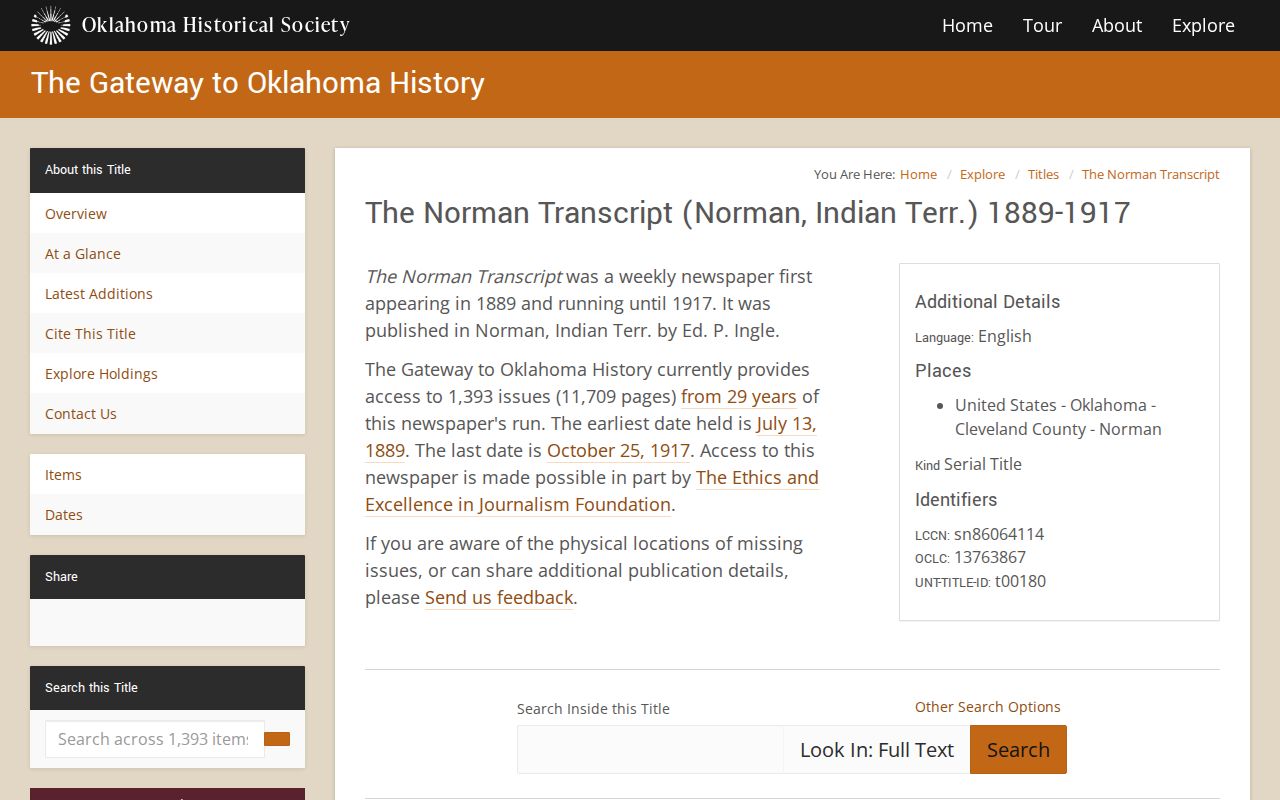
A newspaper mention establishes only what that dated item says. It can support a directory lead, but it does not replace the original directory entry or a recorded instrument.
Smith's First Directory of Oklahoma Territory offers another early lead. Its 1890 volume has a Norman section around page 206 and an index around page 337. Confirm the scanned page before treating a transcription or search snippet as a final citation.
Reading a Norman City Directory Listing
First identify the type of listing. A Norman household listing may be alphabetical, a classified-business entry, a telephone listing, or a reverse address section. The directly inspected September 6, 1890 Norman Transcript page contains a municipal-officer directory block, not a complete resident listing. It names the mayor, councilmen, clerk, attorney, and marshal. Its visible OCR errors are a reminder to preserve the scan's spelling and page number.
| Name as printed | Keep initials, suffixes, and spelling exactly as the volume gives them. |
|---|---|
| Relationship notation | A spouse in parentheses, a widow notation, or another relationship can distinguish people with the same name. |
| Occupation or affiliation | Record it only as printed, along with any business or institution named in the entry. |
| Street address | Capture the number, directional, and street form used in that year. |
| Code and page | Photograph the abbreviation key and record the directory year and page. |
Some volumes use homeowner, occupancy, widow, boarding, telephone, or household codes. The research did not capture a Norman household abbreviation key. That is a research gap, so consult the key printed in the actual volume instead of importing meanings from another city's directory.
Terms Used in Norman City Directories
Directory labels are easy to overread. Preserve the volume's own title and key before deciding what a listing establishes.
- Criss-cross directory
- An address-ordered section that can point from a street address to a listed name. Norman cross-index holdings are reported broadly for the 1930s through 1960s, not as a complete online run.
- Householder index
- An alphabetic or household-focused listing. It may omit people who were not included under the publisher's conventions.
- Abbreviation key
- The printed explanation for shorthand used in that specific directory. The key controls the meaning of marks such as relationship or residence notes.
- OCR
- Machine-read text from a scan. It speeds a search but can confuse initials, names, and street numbers.
A directory entry is a dated publication record. It is not continuous proof that someone stayed at the address throughout the year.
Tracing a Norman City Directory Household
Build a short chronology rather than a loose pile of hits. Start with one printed name and year, then follow the same name, spouse notation, initials, and address through available volumes. A change in address can provide the time window for a deed, newspaper, census, or obituary search. A disappearance can reflect a move, death, omission, or a missing volume. It should be recorded as unresolved until another source answers it.
- Find the earliest confirmed entry and save the city directory year, page, and exact printed name.
- Move forward through confirmed volumes, noting every street form, spouse notation, affiliation, and abbreviation.
- Use a cross-index only when the holding volume actually has one, then record whether the result is name-to-address or address-to-name.
- Pair a directory date with the appropriate public federal census release and retain each source's date separately.
- Check the Norman Transcript, deed index, obituary, or archive finding aid for the period of a move or disappearance.
For a current parcel or full street chain, the Norman Street Directory has the address-keyed county and city routes. Historical listings remain best for a dated household lead, not a present-day occupancy claim.
Norman Directory Dates and Turning Points
Known dates help set expectations without inventing a complete publication history.
| 1889 | Norman Transcript title run begins in Gateway, and Norman's settlement-era terms begin appearing in local research. |
|---|---|
| 1890 | Smith's First Directory includes a Norman section; the September Transcript has a municipal-officer directory block. |
| 1908 | OHS survey cites C. R. Wallin and Co.'s Norman city directory as the earliest known Norman directory. |
| 1941 | OHS survey cites a Southwestern Bell Norman telephone directory and notes that it is not criss-cross. |
| 1930s-1960s | Norman Public Library bibliography reports cross-index directories in this broad period; exact individual years were not published. |
The County Clerk online index does not state its earliest coverage or an imaging cutover. Older deed books or microfilm should be requested from the Clerk when a household chronology reaches beyond an online search result.
Norman Neighborhood Labels as Search Terms
Neighborhood names can focus an archive or newspaper search, but they are not parcel boundaries. Original Townsite carries an 1889 plat context. First Courthouse has published boundaries and a documented disagreement over the former courthouse location. Miller Historic District connects to the 1903 Classen-Miller Addition and a largely 1910-1938 building period. Old Silk Stocking, Southridge, University, Larsh-Miller, and other City labels can also help identify likely planning or historical sources.
Use the Original Townsite page or other official planning material for neighborhood vocabulary, then match that vocabulary to a directory year, Sanborn sheet, or historical newspaper. A planning name alone does not prove that a household was inside a modern district.
Municipal Files Alongside a Norman City Directory
Directories are not the only local reference source. The Norman City Clerk is the custodian for municipal ordinances, resolutions, agendas, minutes, licenses, and administrative records. A narrow request through the City records request route can be useful when a dated directory lead points to a specific City record. Municipal Court is separate from Cleveland County District Court, and City records should not be used as a substitute for county deeds or district-court files.
The Pioneer Library resources page is shown below because it identifies the system's genealogy and newspaper databases. Access can depend on a library card or being inside a branch, so the source should be checked before beginning a remote search.

Library databases work best when a search record keeps the source title, access date, and printed page or issue reference. That makes later verification possible.
The OHS city-and-year directory form is another documented access point for the historical shelf.
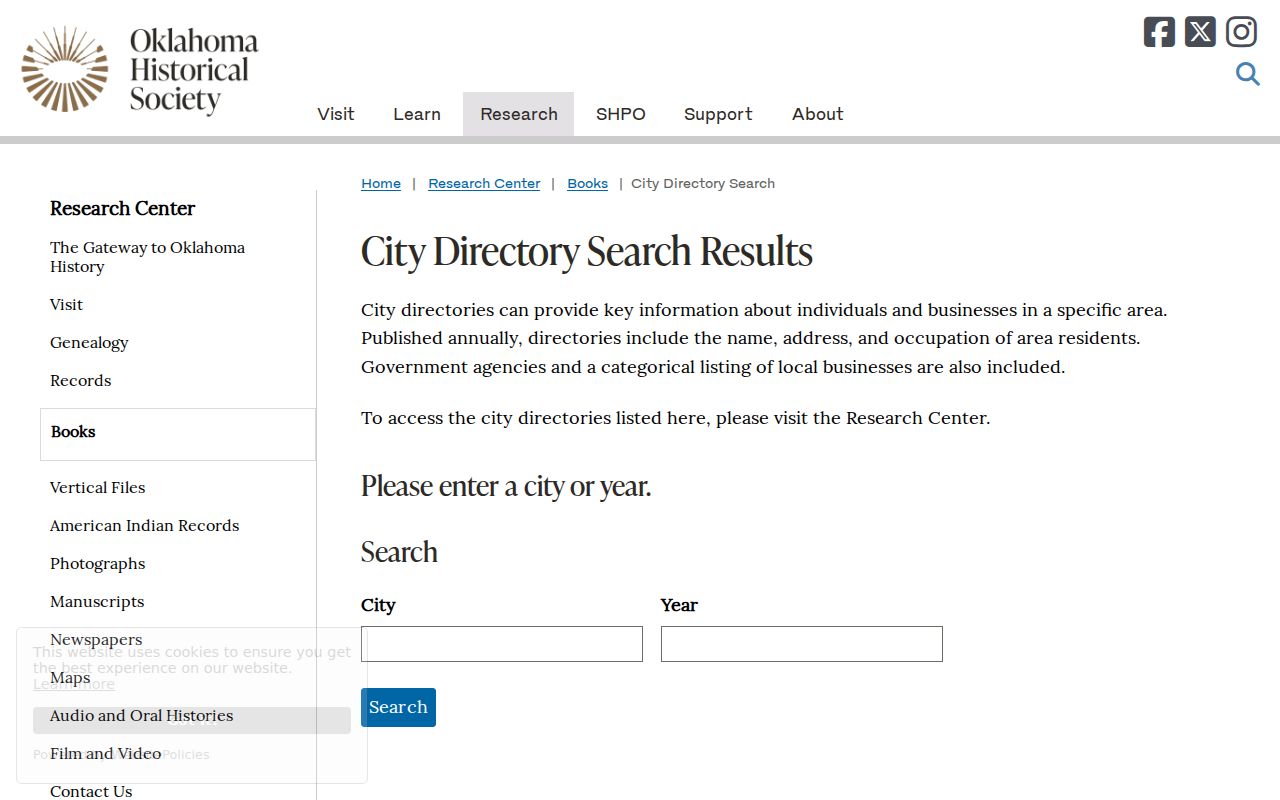
Because results are consulted at the Research Center, the form is a location tool rather than an online directory database.